
Starting a business does not mean giving your notice.
Lots of entrepreneurs build their first business around an existing job, using evenings, weekends or a few spare hours each week to see whether their idea works. Keeping your regular income removes the immediate pressure of “how am I going to pay myself?!?” And give you space to learn what customers actually want.
How can you start your own side hustle without taking on too much at once?

Can I Be Employed and Self-Employed?
In short, yes, you can. You can be employed and self-employed at the same time in the UK.
You could work for an employer during the day, then sell products, take on freelance work or provide a service outside your contracted hours. GOV.UK confirms that a person can hold both employed and self-employed status at once.
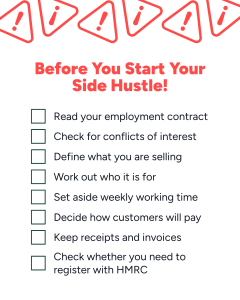
Before accepting your first customer, read through your employment contract. Pay particular attention to anything about:
- Second jobs
- Conflicts of interest
- Confidential information
- Intellectual property
- Contacting your employer’s customers
Most side businesses will not cause a problem, especially when they are unrelated to your main role. Even so, it is better to understand the terms of your employment before money starts changing hands. ACAS has further guidance on employment contracts and workers’ rights.
Begin With Something You Can Explain Clearly
Early business ideas are often broader than they need to be.
“I want to help small businesses with marketing” could cover dozens of services. “I create social media content for independent restaurants” gives people a much clearer picture of what you do and who it is for.
Try describing your idea by answering three questions:
- What are you selling?
- Who would buy it?
- Why would they choose to pay for it?
You do not need a polished website or detailed brand identity to answer those questions. A simple explanation is enough to begin speaking to potential customers.
Those conversations may also change your original idea. That is useful. It is far easier to adjust a service before investing money in equipment, stock, software or advertising.
Look for Evidence, Not Just Encouragement
Friends and family may tell you that an idea sounds brilliant. Their support can be helpful, but it does not always tell you whether there is a paying market.
Speak to people who resemble the customers you hope to work with. Ask how they currently deal with the problem, what frustrates them and what they would expect to pay for a possible solution.
Then find a small way to test it.
That might mean completing one paid project, running a trial session, releasing a limited number of products or offering a basic introductory package.
The test does not have to produce a large profit. At this stage, you are looking for signs that people understand the offer, see a reason to buy and are willing to spend money on it.
Find a Routine That Fits Around Your Job
Starting a side business in the UK while employed usually means working with limited time.
Be honest about what you can commit to without harming your performance at work or leaving yourself exhausted. Two evenings and a Saturday morning may be more sustainable than trying to work on the business every night.
Decide when you will handle different tasks. For example:
- Tuesday evening for enquiries and customer work
- Thursday evening for marketing
- Saturday morning for invoices and planning
A routine like this also makes it easier to see whether the business can fit into your life before it grows.
Focus first on activities linked to customers and income. You can improve your website, branding and internal systems later. Speaking to customers, completing paid work and keeping accurate financial records deserve attention much earlier.
How Does Tax Work
Your employer will deduct Income Tax and National Insurance from your wages through PAYE (Pay As You Earn).
Income from your business is treated separately. Depending on how much you earn, becoming self-employed while employed may mean registering for Self Assessment.
Under current rules, you will generally need to register as a sole trader when your gross trading income goes above £1,000 in a tax year. Gross trading income is the total amount received before expenses are taken away.
The tax year runs from 6 April to 5 April. When registration is required, you would normally need to tell HMRC by 5 October after the relevant tax year ends.
The £1,000 trading allowance has exceptions. You can check if you need to tell HMRC about additional income here.
Keep All Financial Records
Save invoices, receipts, sales information and evidence of business expenses from the beginning. HMRC requires sole traders to keep records for Self Assessment.
Some people also open a separate bank account for business income and spending. It can make record-keeping simpler, even where a dedicated business account is not legally required.
Choose One First Action
Your first action could be reading your employment contract, speaking to a possible customer or working out how many hours you can commit each week.
Enterprise Made Simple supports people across North East England who are considering self-employment or working on an early business idea.
Visit the Start a Business to find training and support suited to your current stage.